
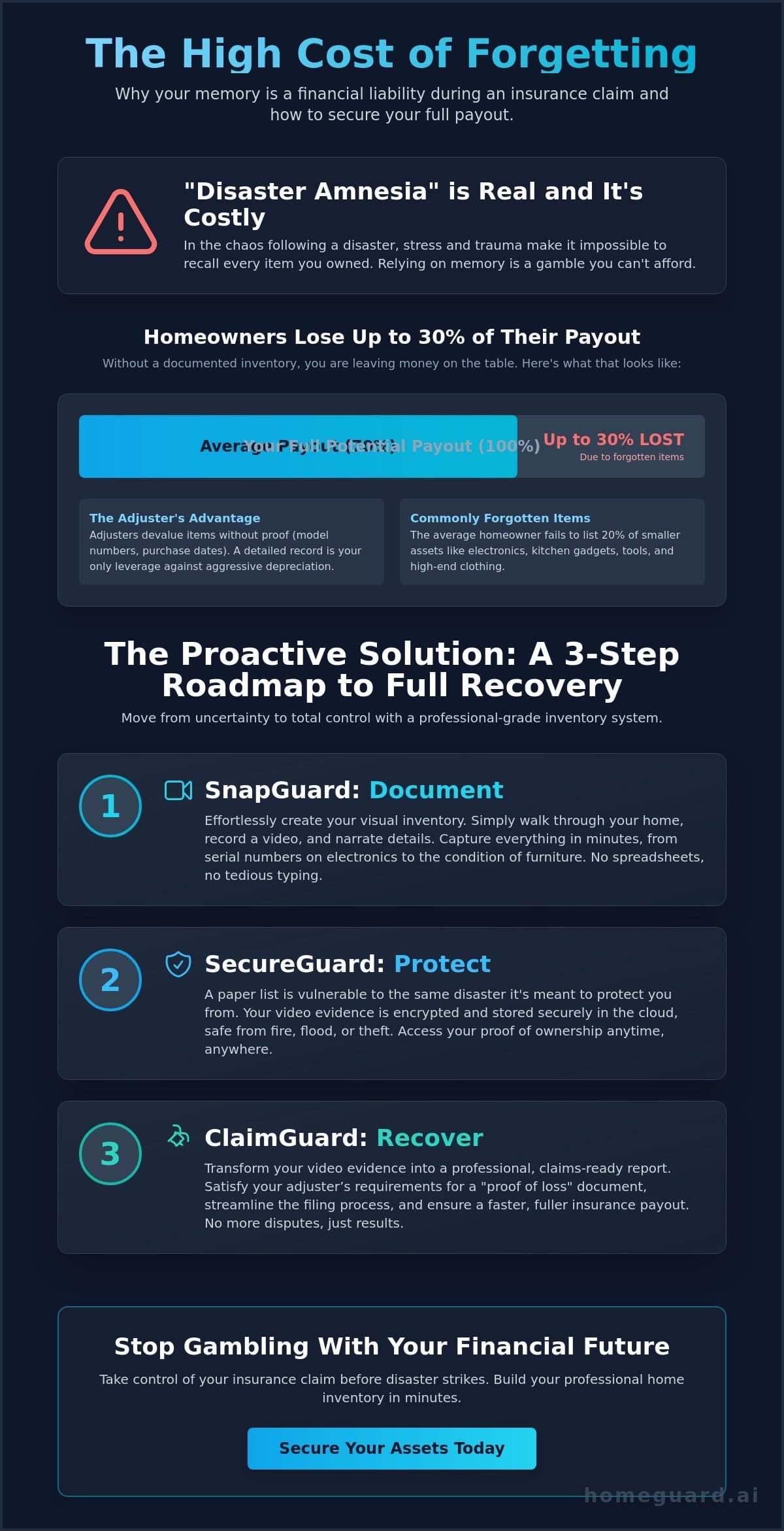
Your memory is your greatest financial liability during an insurance claim. Industry data from 2024 shows that homeowners without a documented record often lose up to 30% of their potential payout because they simply cannot recall every item they owned. You likely feel overwhelmed by the volume of your belongings and worried that a standard inventory list won’t satisfy a skeptical adjuster. You’re right to be cautious. The chaos of the aftermath is the worst time to try and remember the model number of your laptop or the purchase date of your heirloom jewelry.
This guide will teach you how to build a professional-grade inventory list that guarantees you recover every dollar you’re owed. By using the tools at HomeGuard, you can move from uncertainty to total control. We’ll show you how to use SnapGuard to record your home in minutes. No spreadsheets required. You’ll learn to use SecureGuard to keep that evidence safe and ClaimGuard to streamline your future filing. We’re providing a systematic three-step roadmap to document your assets, satisfy adjuster requirements, and ensure a faster insurance payout.
Key Takeaways
- Understand why “Disaster Amnesia” makes relying on memory a financial risk and why proactive documentation is your only defense.
- Master the tactical room-by-room walkthrough required to build a professional inventory list that captures critical metadata and serial numbers.
- Identify the high-value asset categories, from HVAC units to media suites, that are most frequently overlooked during insurance claims.
- Discover how SnapGuard simplifies the documentation process by allowing you to walk, record, and narrate your assets with zero friction.
- Learn the essential difference between a simple record and professional proof of loss to ensure you recover every dollar through HomeGuard.
Why a Home Inventory List Is Your Most Critical Financial Asset
A home inventory list is a comprehensive, itemized record of your personal property designed for immediate insurance verification. It is not a casual “to-do” list. It is a professional proof of loss document that bridges the gap between what you owned and what the insurance company pays you. To maximize your recovery, you must first understand what is insurance at its core: a legal contract where the insurer compensates you for documented loss. Without that documentation, the contract remains unfulfilled. For Kansas City homeowners, this record is a shield against the region’s volatile climate. Following the 12% increase in severe hail events across Missouri in 2025, immediate access to property records has become the difference between a full recovery and a financial disaster. Replacement Cost Value (RCV) is the total dollar amount required to replace your lost items with brand-new equivalents of similar quality, and your ability to collect this full amount depends entirely on the accuracy of your listing.
The Financial Impact of an Incomplete Listing
Missing items on a claim result in thousands of dollars in unclaimed insurance money. The average homeowner fails to account for 20% of their smaller assets, such as electronics, kitchen appliances, and high-end clothing, during the stress of a post-disaster claim. This oversight is compounded by depreciation. Insurance adjusters are trained to reduce the value of your items based on age and wear. Detailed descriptions, including brand names and purchase dates, allow you to fight back against aggressive depreciation schedules. Under the 2026 Missouri Department of Commerce and Insurance transparency standards, claimants must provide “clear and verifiable evidence” to challenge an adjuster’s valuation. If you cannot prove the specific model of your 4K television or the designer of your furniture, the insurer will default to the lowest possible market value. Preparation is your only defense against these systemic losses.
Inventory Listing vs. Digital Asset Management
A simple paper list is a liability, not an asset. Physical records are vulnerable to the same fires, floods, and storms they are meant to document. Relying on a notebook stored in a kitchen drawer is a gamble you will eventually lose. Professional digital asset management through HomeGuard transforms a static list into a secure, cloud-based recovery tool. Using SnapGuard, you can capture visual evidence and serial numbers in minutes. This data is then stored off-site in an encrypted environment like SecureGuard, ensuring it remains accessible even if your home is leveled. For KC residents, off-site storage is a practical necessity. When the sirens sound, you don’t grab a binder; you grab your family. By the time you need to file a claim with ClaimGuard, your digital inventory list is already waiting for the adjuster. Memory fails under pressure. Secure, digital documentation does not.
The Psychology of Loss: Why Memory Fails After a Disaster
Many homeowners fall into a dangerous trap. They assume they can recall their belongings after a disaster strikes. This is a financial mistake. Psychological studies show that trauma triggers “Disaster Amnesia.” When your adrenaline spikes and your home is gone, your brain prioritizes survival over the brand name of your coffee maker. You won’t remember the specifics. You will lose money because of it.
Memory fails because it’s subjective. Insurance adjusters, however, are objective. They don’t trade in “I think so” or “I had a lot of clothes.” They demand hard data. They want the brand, the age, and the current condition of every asset you claim. To help you structure this data effectively, you can consult this official home inventory guide from the California Department of Insurance. Preparation is the only way to bypass the cognitive fog of a crisis.
The Invisible Items We Forget to Document
You likely remember the big-ticket items like your 4K TV or your leather sofa. You’ll almost certainly forget the “invisible” items that sit in drawers and closets. These small goods represent significant “leakage” in your claim. Consider these commonly missed categories:
- Kitchen Essentials: Spices, high-end oils, and small appliances like mixers or blenders.
- Linens: Egyptian cotton sheets, heavy wool blankets, and designer towels.
- Cleaning Supplies: Vacuum cleaners, specialized tools, and a full cabinet of detergents.
- Holiday Decor: Ornaments, artificial trees, and seasonal lighting stored in the attic.
The cumulative value of these items is staggering. In a 2023 post-fire audit, one homeowner realized they had forgotten $4,200 worth of kitchen pantry staples and cleaning supplies alone. This is why a comprehensive inventory list must account for every cabinet. If you don’t document it now, you’re donating that money back to the insurance company.
Why Spreadsheets Alone Are Not Enough
A spreadsheet is just a list of assertions. A video is a list of facts. Adjusters are trained to be skeptical of manual lists that lack visual context. If you claim a high-end blender but have no photo, you might receive the value of a generic $30 model. The proof burden rests entirely on you. You need a system that connects your written inventory list to visual evidence.
The HomeGuard method replaces manual fatigue with action. Instead of typing for hours, use the SnapGuard philosophy: walk, record, and narrate. This simple action turns your phone into a forensic tool. You walk through the room, record the scene, and narrate the details. It’s faster than typing and much harder for an adjuster to dispute. Linking these digital records through SecureGuard ensures your evidence is vaulted and ready before the chaos begins.
By the time you need to use ClaimGuard to file your paperwork, you’ll have more than just a list. You’ll have a digital twin of your assets. Don’t leave your financial recovery to chance. Start your protection plan today at homeguard.ai and secure your future.
How to Build a Professional-Grade Inventory Listing for Insurance
Memory is a liability during a crisis. After a total loss, the stress of the event can erase 50% of your ability to recall specific household details. You don’t need a vague list of “stuff.” You need a professional-grade inventory list that functions as a financial recovery blueprint. At HomeGuard, we’ve seen that documentation is the only bridge between a denied claim and a full payout.
Follow this five-step tactical protocol to secure your assets:
- Step 1: The Tactical Walkthrough. Start at the curb. Record the exterior and landscaping before moving room-by-room. Use SnapGuard to narrate as you walk. Talk about when you bought the item and what it cost.
- Step 2: Capture Metadata. A photo of a TV isn’t enough. You must record the brand, model number, and serial number. This data prevents adjusters from “depreciating” your 2026 OLED to the price of a 2018 base model.
- Step 3: Document High-Value Assets. Items like jewelry, fine art, or specialized hobby equipment require professional appraisals. The American Society of Appraisers recommends updating these documents every 24 months to reflect current market values.
- Step 4: Secure Digital Storage. Paper lists burn. Spreadsheets get lost. Move your data to SecureGuard for encrypted, off-site cloud storage that’s accessible even if your hardware is destroyed.
- Step 5: Regular Maintenance. Your home is dynamic. Update your inventory list every January and July. Significant purchases made during holiday sales or birthdays must be added immediately to maintain coverage accuracy.
Room-by-Room Strategy for Maximum Efficiency
In the kitchen, don’t just snap the fridge. Open the cabinets. High-end cookware and small appliances often total over $4,000 in hidden value. For the living room, document electronics and custom window treatments. Many homeowners forget that custom drapes can cost $600 per window. In the garage or basement, focus on power tools and seasonal gear. A standard tool chest can easily hold $2,500 in assets that are frequently overlooked during claims.
Capturing Proof of Purchase in 2026
Paper receipts fade and disappear. For older items where the physical receipt is gone, use digital bank records. Most banking apps allow you to export transaction histories from the last 24 months. If you bought items online, your email archive is a goldmine. Search for “order confirmation” and “shipping notice” to find secondary proof. Use SecureGuard to centralize these PDFs and screenshots. This ensures that when you work with ClaimGuard later, every item on your list has a corresponding digital footprint. Preparation is the only logical choice for the modern homeowner.
Essential Categories Every Personal Inventory Must Include
Memory fails when disaster strikes. You cannot rely on your brain to recall thousands of assets while standing in a pile of debris. A professional inventory list categorizes your home into high-impact zones to ensure no dollar is left on the table during a claim. Insurance adjusters require proof, not guesses. By organizing your documentation into these four pillars, you build a financial defense that is difficult to challenge.
- Major Appliances: Document your HVAC units, water heaters, and high-end kitchen suites. A replacement HVAC system in 2026 can cost upwards of $11,000. Note the model and serial numbers for every unit.
- Electronics and Media: Computers, gaming systems, and home theater audio are high-depreciation items. Detail the specs of your workstations and the brand of your sound system. These items are often the first to be stolen; utilizing professional monitoring from Mega Control Security Services can help prevent such losses or damage from power surges.
- Clothing and Textiles: Do not list every individual shirt. Instead, estimate the bulk value of your full wardrobe and high-quality linens. A standard professional wardrobe often represents a $15,000 replacement investment.
- Tools and Outdoor Gear: Lawn mowers, power tools, and patio furniture are frequently forgotten. A single zero-turn mower or a professional-grade power tool set can easily exceed $7,000 in value.
High-Value Items and Specialized Appraisals
Standard policies have internal limits for specific categories. In Missouri, the 2026 threshold for scheduled items like jewelry, watches, or furs typically caps at $2,500 per item. Assets like vehicles are not included in your personal property inventory because they require separate auto coverage. For collections involving coins, stamps, or rare wine, you must obtain professional appraisals. Document these specialized riders and store the digital certificates in SecureGuard to prevent loss during a fire or flood.
The Narrated Video Shortcut
Writing a manual list takes weeks. Video is 10 times faster, and it is significantly harder for adjusters to dispute. Use SnapGuard to record a comprehensive walkthrough of every room. Open every closet and drawer. Your narration is the key. Say the brand, purchase date, and approximate price out loud while the camera focuses on the item. This creates a timestamped, narrated record that proves ownership and condition simultaneously. It turns a daunting task into a simple two-hour afternoon project. If you can walk and talk, you can secure your claim.
Simplify Your Documentation with HomeGuard: From Video to Claims-Ready
HomeGuard wasn’t built in a boardroom; it was born from the ashes of a Kansas City house fire. After our founder navigated the brutal reality of a total loss, the mission became clear: homeowners need a better way to prove what they own. Memory fails under stress. Paper lists get lost. HomeGuard provides the systematic defense you need to face an insurance adjuster with total confidence. We bridge the gap between what you own and what you can actually recover.
The process starts with SnapGuard. This walk and record feature removes every barrier to creating a comprehensive inventory list. You don’t need to learn complex software or spend days typing serial numbers into a phone. Just walk through your home, record the items, and narrate the details as you go. It’s zero-friction documentation that captures every asset in high definition. If you can take a video of your family, you can protect your financial future.
Once recorded, your assets move to SecureGuard. This is your vault for long-term, encrypted asset management. Storing data on a USB drive or a local hard drive is a gamble you shouldn’t take. If the disaster that destroys your home also destroys your documentation, you’re left with nothing. By hosting your data at www.homeguard.ai, we ensure your records are safe, off-site, and accessible from any smartphone the moment you need them.
The HomeGuard Advantage for KC Homeowners
We understand the specific challenges of the Kansas City insurance landscape. Our system is designed by a local survivor who knows exactly what adjusters look for in this region. Security is our priority; cloud storage is objectively safer than physical drives that can be misplaced or melted. Most importantly, we’ve removed the complexity. There are no spreadsheets to manage and no technical jargon to master. It’s professional-grade protection for everyday families who value their time.
Your Next Steps to Total Preparedness
Don’t wait for a “someday” that might come too late. Download the HomeGuard Complete kit today to start your documentation immediately. We recommend scheduling a two-hour Inventory Sunday this weekend. It’s a small time investment that could save you six figures in a future claim. To see how we handle the recovery phase, learn more about ClaimGuard and prepare your family for the claims process before the chaos begins. Protect what you own; recover what you lose.
Secure Your Financial Defense Today
Memory isn’t a reliable database. When disaster strikes, the immediate stress can impair cognitive recall, making it nearly impossible to remember every asset you’ve acquired over the years. A professional-grade inventory list isn’t just a weekend project; it’s your primary financial defense against a low-balled insurance settlement. You need a system that survives the disaster even if your physical documents don’t. HomeGuard was founded by a residential fire survivor who learned this reality the hard way. By using SnapGuard to walk and record your belongings and SecureGuard for encrypted cloud storage, you move from chaos to total control. A single one-time fee provides lifetime peace of mind and ensures that ClaimGuard has the evidence needed to prove your losses. Don’t wait for a crisis to realize you’re under-prepared. Protect your investment and ensure your recovery starts the moment you need it most.
Protect What You Own-Get the HomeGuard Complete System
Frequently Asked Questions
What is the best way to start an inventory list if I have no receipts?
Use visual proof and serial numbers to establish ownership when you don’t have paper receipts. Walk through your home and record a video narrating the age, brand, and condition of every major asset. This visual record serves as a primary source for your inventory list. For a faster process, use SnapGuard to capture photos and metadata that prove you owned the item before the loss occurred.
How often should I update my home inventory for insurance claims?
Update your documentation at least once every 12 months or immediately after any purchase exceeding $500. Routine updates ensure your coverage matches your current assets. According to 2024 industry data, 60% of homeowners are underinsured because they fail to log new acquisitions. A quick annual walkthrough keeps your records current and your financial recovery secure. Don’t let your coverage lag behind your lifestyle.
Does a video inventory count as a legal document for insurance?
A video inventory serves as powerful supporting evidence but isn’t a standalone legal contract. It functions as a visual affidavit that proves the existence and condition of your property. Insurance adjusters prioritize clear, narrated footage because it’s harder to dispute than a written list alone. Use SnapGuard to create a time-stamped record that stands up to carrier scrutiny during the recovery process.
Should I include small items like clothing and kitchenware in my list?
You must include bulk items because their cumulative value often exceeds $10,000 for an average three-bedroom home. Don’t list every individual spoon; instead, group items by category and estimate the total count. Photograph open closets and cabinets to show the volume of goods. This prevents the “forgotten asset” trap where thousands of dollars in smaller items are left off the final claim payout.
Where is the safest place to store my digital home inventory spreadsheet?
Store your digital records in an encrypted, cloud-based vault rather than on a local hard drive that could be destroyed. A local file is useless if your computer is lost to fire or water. Use SecureGuard to maintain a redundant, off-site backup of your inventory list. This ensures you can access your data from any smartphone immediately after an emergency strikes your property.
What happens if I don’t have an inventory list after a house fire?
You will likely lose 20% to 40% of your potential settlement because memory fails under the stress of a disaster. Without a list, the burden of proof falls entirely on you to recall thousands of items from a pile of ash. This leads to “claim fatigue” where homeowners settle for less just to end the process. Visit HomeGuard to prevent this financial drain before it happens.
Are there specific items that are not included in a personal property inventory?
Standard personal property inventories exclude motorized vehicles, such as cars or boats, which require separate specialized policies. If you’re also looking to explore Auto Insurance, SI Insurance offers coverage options that can fill these gaps. Most policies also limit coverage for high-value items like jewelry or fine art to a flat $1,500 or $2,500 unless you add a specific rider. Check your policy declarations page for these “sub-limits” to ensure your most expensive assets are actually protected by your current insurance plan.
Can I use a free home inventory template for a large insurance claim?
You can use a free template, but manual spreadsheets often lack the time-stamped metadata and photo integration required for complex claims. Large-scale losses require professional-grade documentation to bypass adjuster skepticism. If your claim exceeds $50,000, specialized tools like ClaimGuard provide the structured data needed to accelerate your payout and prove every dollar of loss without the manual errors of a basic sheet.