
Industry data shows the average homeowner loses roughly 20% of their total claim value because they cannot prove what they owned before the disaster. It’s a brutal reality: memory fails when you’re standing in the wreckage of your living room. You shouldn’t have to rely on a hazy recollection to recover your life’s work. Creating a comprehensive home inventory is the only way to turn the tables on insurance adjusters. At HomeGuard, we believe in financial self-defense. If you can’t prove it, you don’t own it.
You likely feel that documenting every asset is a tedious task that takes weeks of spreadsheets. You’re right to be skeptical of the manual process, but you’re wrong to wait until it’s too late. This guide will teach you how to create a professional-grade record of your assets in a single afternoon. By using SnapGuard to walk, record, and narrate your belongings, you’ll build a digital fortress around your net worth. We’ll show you how to store that evidence with SecureGuard and leverage ClaimGuard to ensure your insurer pays every cent you’re owed. This is your clear plan for total disaster recovery in 2026.
Key Takeaways
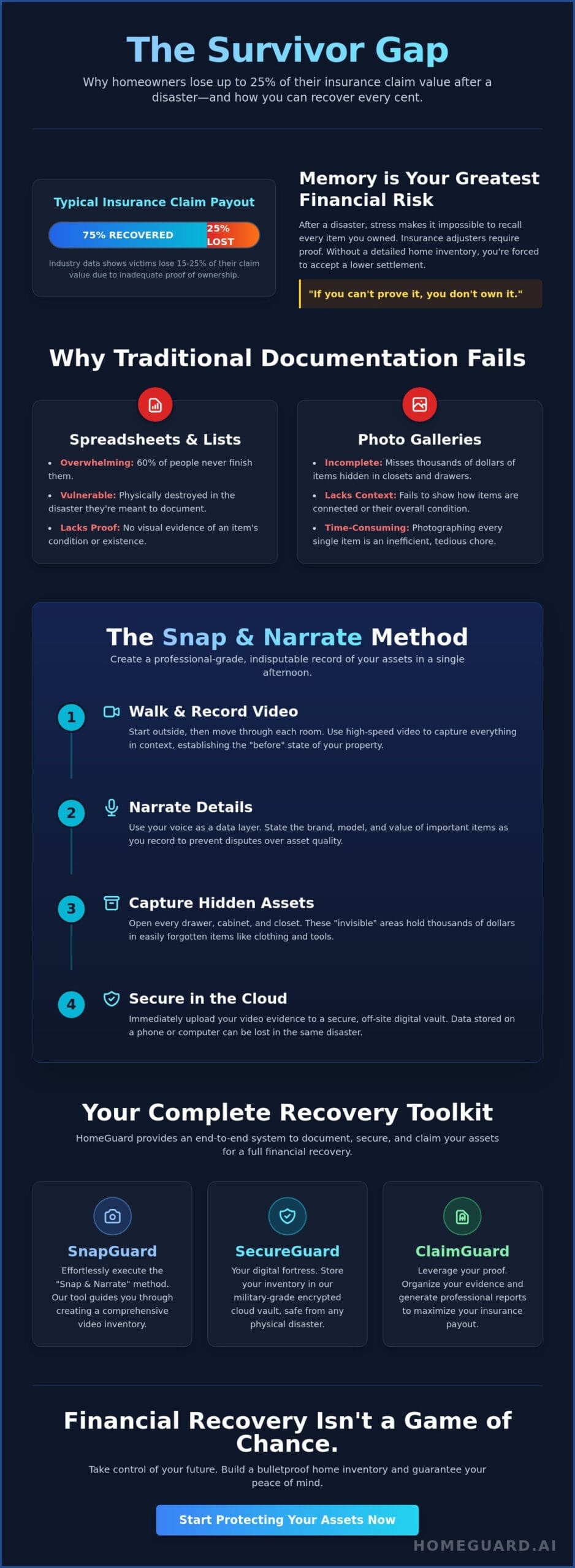
- Stop relying on memory and close the “Survivor Gap” that causes disaster victims to lose up to 25% of their total claim value.
- Master the “Snap and Narrate” method to build a bulletproof home inventory using high-speed video evidence and HomeGuard tools.
- Learn why traditional spreadsheets fail and how SnapGuard streamlines documentation for faster, more accurate insurance processing.
- Follow a localized Kansas City checklist to protect high-value assets in your kitchen and garage from common regional risks like wind and hail.
- Ensure your financial recovery is guaranteed by storing critical evidence in the SecureGuard digital vault for military-grade protection.
What is a Home Inventory and Why is Memory Your Greatest Risk?
A home inventory is a comprehensive, documented record of your personal property created specifically for insurance purposes. It isn’t just a list; it’s your financial shield. To grasp the fundamentals of asset tracking and valuation, reviewing What is an Inventory provides a baseline for how professional systems operate. In the wake of a disaster, this record serves as the only bridge between your lost assets and a fair settlement.
Most homeowners suffer from the “Survivor Gap.” Data from disaster recovery experts shows that victims typically leave 15% to 25% of their claim value on the table because they cannot recall every item they owned. Memory fails under stress. Documenting your home “Before” is a simple, calm process. Attempting to recollect “After” a trauma is an impossible task that costs you money. Your primary goal is to provide a “Proof of Loss” that an insurance adjuster cannot dispute. If you can’t prove you owned it, you won’t be paid for it.
The Financial Cost of Being Unprepared
Insurance companies calculate payouts based on Actual Cash Value (ACV) or Replacement Cost. Without documentation, adjusters often apply heavy depreciation or miss high-value items entirely. Legally, the burden of proof rests on the homeowner, not the insurer. You must demonstrate exactly what was lost to receive your full entitlement. Using tools like ClaimGuard ensures you meet these strict requirements. “In the eyes of an insurance adjuster, if it isn’t documented, it never existed.”
Why Traditional Lists Often Fail
Handwritten notebooks are a major risk. They are often destroyed in the same fire or flood they were meant to document. Beyond physical risk, the “overwhelmed” factor stops approximately 60% of people from ever finishing their lists. They get bogged down in manual spreadsheets and serial numbers. At HomeGuard, we replace simple list-making with professional Asset Documentation. Don’t waste weeks on a paper notebook. Use SnapGuard to walk, record, and narrate your belongings in minutes. Then, secure that data in the cloud with SecureGuard. This approach turns a chaotic chore into a structured, indisputable digital asset that stays safe even if your home is lost.
The Snap and Narrate Method: Documenting Your Home in Minutes
Memory is a liability. In the high-stakes environment of a 2026 insurance claim, “I think I had that” is a losing strategy. You need a home inventory that functions as undeniable proof. High-speed video has emerged as the most robust form of evidence available. It replaces the faulty human memory with a timestamped, visual record of every asset you own. It’s fast, it’s objective, and it’s your only path to a full recovery.
Step 1: The Room-by-Room Walkthrough. Start at the curb. Record the exterior, the roof, and the siding. Move inward. Document each room by rotating slowly in the center of the space. This establishes the context and condition of the entire property before you dive into the details.
Step 2: The Narrative Layer. Don’t just record in silence. Use your voice as a secondary data point. Speak the brand, the model, and the approximate age of items out loud. This audio layer makes it impossible for adjusters to claim a high-end appliance is a generic model.
Step 3: Capturing the Hidden Assets. Open every drawer. Pull back the closet doors. Peek into the storage bins in the garage. These “invisible” areas often contain thousands of dollars in clothing, tools, and electronics that are easily forgotten after a disaster.
Step 4: Secure Upload. A video stored only on a damaged phone is useless. You must ensure the data is off-site and cloud-protected immediately. Verification is the final step in securing your financial future.
Why Video Outperforms Photos and Spreadsheets
Video captures the context and condition of multiple items simultaneously. It shows the relationship between your assets; it proves that the 75-inch television was mounted on the wall and functional. Claims adjusters are human. They respond to the undeniable reality of a video walkthrough more than a static list. The speed advantage is undeniable. You can document a 250-square-foot living room in 3 minutes. A manual spreadsheet for the same space takes 30 minutes or more. According to the United Policyholders guide to home inventories, this level of detail is the difference between a disputed claim and a prompt payout.
Critical Items to Narrate for Maximum Recovery
Focus your narration on high-value electronics, kitchen appliances, and designer goods. These are the items where depreciation hits hardest if you can’t prove the specific model. Zoom in on serial numbers and brand tags. Show the “Made in” labels on furniture. SnapGuard simplifies this narration process by providing a structured framework that prompts you to highlight these high-recovery details as you walk. Don’t leave your home inventory to chance. Protect your investment by creating a digital twin of your assets at www.homeguard.ai today.
Home Inventory Tools: Why Spreadsheets and Photo Galleries Fail
Memory fails. When a disaster strikes, your brain prioritizes survival, not the serial number of your 2024 OLED television. Most homeowners assume they are prepared because they have a few scattered photos on their smartphones. This is a dangerous mistake. A professional home inventory requires more than just pixels; it requires structured, admissible evidence. If your records aren’t organized, encrypted, and exportable, you are leaving your financial recovery to chance.
Compare the four standard methods of documentation based on speed, security, and claim readiness:
- Manual Notebooks: Zero speed. Zero security. These physical records often perish in the same fire or flood they were meant to document.
- Basic Spreadsheets: High effort. Low security. They lack the photo integration and metadata required by modern adjusters.
- Generic Cloud Storage: Moderate speed. Fragmented security. Google Photos and Dropbox are “digital junk drawers” where context goes to die.
- Specialized Systems: High speed. Maximum security. Systems like HomeGuard provide a structured framework designed specifically for insurance compliance.
The biggest objection homeowners raise is simple: “Why can’t I just use my phone gallery?” The answer is metadata and organization. A photo of a laptop doesn’t prove its purchase date, its internal specifications, or its current replacement value. Without a structured system, you spend hours scrolling through thousands of personal photos to find one blurry image of a receipt. Adjusters need data, not a scavenger hunt. If you’re ready to upgrade from scattered photos to a purpose-built home inventory app that transforms your smartphone into a high-speed insurance recovery tool, the difference in claim outcomes is significant.
The Problem with Free Templates and Spreadsheets
Free templates are a data entry trap. Research shows that 65% of people who start a manual spreadsheet inventory never actually finish it. It becomes a second job that demands hours of typing and manual photo linking. Beyond the boredom, there is the risk of local file loss. If your inventory lives on a laptop that sustains water damage, your records are gone. Using a cloud-based SecureGuard system ensures your data exists independently of your hardware. Most free templates also lack the specific fields required by major 2026 insurance policies, such as depreciation markers and verified appraisal attachments. For homeowners who want a more structured starting point, a professional digital home inventory spreadsheet built for insurance compliance can bridge the gap between basic record-keeping and claim-ready documentation.
Specialized Apps vs. Generic Storage
Generic storage platforms like iCloud or OneDrive are built for convenience, not recovery. They don’t offer “Claim-Ready” exports. When you file a claim, you need to hand the adjuster a professional, itemized report that calculates total loss values instantly. A specialized home inventory tool like SnapGuard allows you to walk, record, and narrate your assets in a fraction of the time. This creates a permanent, encrypted record that stands up to scrutiny. If you want a comprehensive comparison of the best home inventory app options for 2026 to find the right fit for your documentation needs, evaluating purpose-built tools against generic storage makes the choice clear. While many apps trap you in monthly subscription cycles, professional-grade systems prioritize lifetime access. Protect what you own. Recover what you lose. Don’t wait for the “after” to realize you should have acted “before.”
The Kansas City Homeowner Checklist: Essential Assets to Document
Kansas City weather is volatile. In 2023, the metro area faced 53 severe weather warnings. Wind and hail damage account for 40% of Midwest property claims. When a storm hits or a residential fire breaks out, your memory fails. You won’t recall the brand of your dishwasher or the cost of your power tools while standing in the debris. Preparation is your only defense. Whether you own a brand-new “Inventory Home” in Olathe or a historic residence in Brookside, your home inventory must be precise to secure a full payout. If you bought a pre-built Inventory Home, don’t assume the builder’s spec sheet is enough. You’ve added thousands in personal assets since move-in day.
Kitchen and Living Areas: The High-Value Zones
The kitchen is the most expensive room in a Kansas City home. High-end suburbs like Leawood frequently feature built-in appliances from brands like Sub-Zero or Wolf, where a single refrigerator can cost $12,000. Don’t get bogged down by individual forks. Instead, use a Bulk Value approach for smaller items. Bulk Value is the total replacement cost for a collection of similar items, such as a full set of linens or a drawer of everyday cutlery, documented as one unit.
- High-End Appliances: Record model numbers for built-in ovens, ranges, and wine fridges.
- Small Kitchen Electrics: Document air fryers, stand mixers, and espresso machines.
- Windows and Window Treatments: Custom shutters and designer drapes are often forgotten, as are the high-quality windows they cover. Documenting premium installations from Window Galaxy USA ensures you capture their full replacement value in your inventory.
- Linens and Textiles: High-thread-count sheets and premium towels represent a significant “hidden” cost.
Garages and Basements: The Tool and Hobby Trap
Missouri and Kansas basements are prone to flooding. Statistics show that 20% of local homes experience basement moisture issues annually. If your basement is finished, you must prove the quality of the build. Without photos, an insurance adjuster might categorize your $15,000 basement remodel as unfinished storage during a claim. The garage is another area where value is frequently lost. Professional-grade power tools, riding mowers, and seasonal holiday decor represent a massive financial investment. Memory won’t help you list every wrench after a total loss.
- Lawn Equipment: Zero-turn mowers and heavy-duty snow blowers are high-ticket items.
- Power Tools: Document drill sets, table saws, and specialized hobby gear. For those with high-precision technical equipment, referencing documentation from instrumentation specialists like CPS (NZ) Ltd can help establish the professional value and condition of your gear.
- Holiday Decor: The average household owns over $2,000 in seasonal decorations.
- Finished Content: Capture the flooring, drywall, and lighting in finished basement spaces.
Don’t wait for the next storm siren to realize you are underinsured. Use SnapGuard to record your walk-through today and ensure your assets are protected before disaster strikes.
Securing Your Future: How HomeGuard Simplifies Recovery
Disaster doesn’t wait for a convenient time. In Kansas City, where unpredictable storms and flash floods are a seasonal reality, waiting to document your assets is a financial risk you can’t afford. HomeGuard Complete provides the only all-in-one solution designed specifically for local residents who value pragmatism over hope. This isn’t just a list of items; it is a professional-grade defense system for your net worth. It was built by a fire survivor who experienced the crushing weight of the insurance claim process firsthand. After losing everything in a house fire, our founder realized that memory is a poor substitute for proof. He built HomeGuard to ensure no other homeowner is ever left silenced by a lack of evidence.
The core of this protection is the SecureGuard digital vault. Most people store their records on a single laptop or a physical folder. If your home is destroyed, those records vanish with it. SecureGuard utilizes military-grade encryption to host your sensitive data in a secure, off-site environment. Your video walk-throughs, digital receipts, and serial numbers remain accessible even if your physical hardware is lost to fire or theft. You aren’t just storing files; you’re securing your recovery. For a deeper understanding of how to build a complete financial defense strategy, our home inventory protection guide for asset recovery in 2026 walks you through every step of transforming your documentation into a bulletproof claim.
The ClaimGuard Advantage
Documentation is only valuable if it leads to a check. The ClaimGuard retrieval process is engineered to bridge the gap between loss and payout. If your devices are destroyed, our team ensures your inventory data is recovered and ready for submission. Every HomeGuard system includes the “Insurance Claim Recovery Guide.” This tactical manual provides the exact language you need to use when speaking with adjusters to ensure you don’t leave money on the table. We operate on a one-time fee model. You pay once to secure your assets forever. There are no monthly subscriptions or hidden costs to maintain your safety.
Taking Action Before the Storm
Preparation is the only logical choice for the modern homeowner. It’s better to have your home inventory and not need it, than to need it and not have it. When the pressure of a major loss hits, your brain won’t remember the specific model of your refrigerator or the contents of your tool shed. Using the SnapGuard recording tool, you can complete a full digital sweep of your property in under 30 minutes. Just walk, record, and narrate your way to total security.
- Identify your assets: Walk through every room with your phone.
- Narrate the details: Speak clearly about the age and condition of high-value items.
- Upload to the vault: Sync your data instantly to our encrypted servers.
- Rest easy: Know that your proof is permanent and protected.
Don’t let your recovery be dictated by what you can remember. Take control of your financial future before the next storm hits the Midwest. Documentation is leverage, and HomeGuard gives you the upper hand in any insurance dispute.
Protect your Kansas City home with HomeGuard Complete today.
Protect Your Assets and Guarantee Your Recovery
Your memory is your greatest liability after a disaster. HomeGuard was built by a residential fire survivor who understood that spreadsheets and blurry photos aren’t enough to satisfy insurance adjusters. Homeowners across the country have already recovered millions in claims by using this systematic approach to documentation. A professional home inventory doesn’t have to be a burden. With the right tools, you can document your entire property in a single afternoon. Use SnapGuard to record your assets and SecureGuard to keep that data safe from any catastrophe.
If the unexpected happens, ClaimGuard provides the organized evidence you need to get every dollar you’re owed. Don’t leave your financial future to chance or a failing memory. It’s time to trade uncertainty for a one-time flat fee that offers lifetime peace of mind. You’ve worked for years to build your life; take ten minutes to protect it today. You have the power to be prepared, and we’re here to make it simple.
Get the HomeGuard Complete Kit and Secure Your Assets Now
Frequently Asked Questions
Is a home inventory really necessary for a standard insurance policy?
Yes, a home inventory is essential because standard policies require you to provide a detailed list of lost assets to receive a full payout. Without documentation, carriers often apply depreciated value estimates that can cut your settlement by 30% or more. Using SnapGuard ensures you have the visual evidence needed to prove the existence and condition of every item before a disaster occurs.
How often should I update my home inventory list?
You should update your list every 6 months or immediately after acquiring assets valued over $500. Regular updates prevent a 15% gap in coverage that typically occurs when homeowners forget to document new electronics or furniture. A quick walk-through with your phone twice a year keeps your records current. This simple habit ensures your home inventory remains a reliable tool for financial recovery and total asset protection.
What is the fastest way to do a home inventory for a large house?
The fastest method is the walk, record, and narrate strategy using a mobile device. Instead of manual spreadsheets, you can document a 3,000 square foot home in under 90 minutes by filming each room while describing high-value items out loud. This visual record provides 100% room coverage and captures details that written lists miss. Tools like SnapGuard streamline this process by organizing your footage instantly.
Does an insurance company accept video as proof of loss?
Yes, 95% of major insurance carriers accept video documentation as valid proof of loss. Video provides indisputable evidence of an item’s condition and presence within the home. It’s harder for adjusters to dispute a claim when they can see the asset in a high-definition recording. If you need to file a claim, ClaimGuard helps you present this digital evidence to maximize your settlement and speed up the process.
Should I include receipts in my digital home inventory?
You must include receipts for any item exceeding $1,000 to guarantee a full replacement cost payout. Receipts serve as the primary proof of purchase price and date, which prevents insurers from using lower market averages. Digital copies are safer than paper, as 7% of home fires destroy physical records. Storing these documents in SecureGuard ensures they are accessible from any location after a total loss.
What happens if I lose my inventory in the same fire that destroyed my house?
If your inventory is stored locally on a hard drive or paper, it will likely be destroyed along with your home. Data from the NFPA shows that structure fires can reach 1,100 degrees Fahrenheit, melting most physical storage media. You must use a cloud-based system to ensure your records survive. By using SecureGuard, your data is encrypted and stored off-site, making it available the moment you need to rebuild.
Can I do a home inventory if I am a renter in Kansas City?
Yes, renters in Kansas City should maintain a home inventory to protect their personal property. While your landlord’s insurance covers the building, it doesn’t cover your $20,000 worth of furniture, clothes, or electronics. Missouri renters often face complex claims after storm damage or theft. Using HomeGuard tools allows you to prove what you owned so you can recover your security deposit and personal asset value without stress.
What are the most common items people forget to include in an insurance claim?
Homeowners frequently forget to claim invisible assets like window treatments, small kitchen appliances, and seasonal decorations. These items can total over $10,000 in a standard three-bedroom home. Most people focus on big-ticket items like TVs but overlook the $500 worth of spices in their pantry or $2,000 in linens. A comprehensive video walkthrough ensures these small but cumulative costs are included in your final payout from ClaimGuard.