
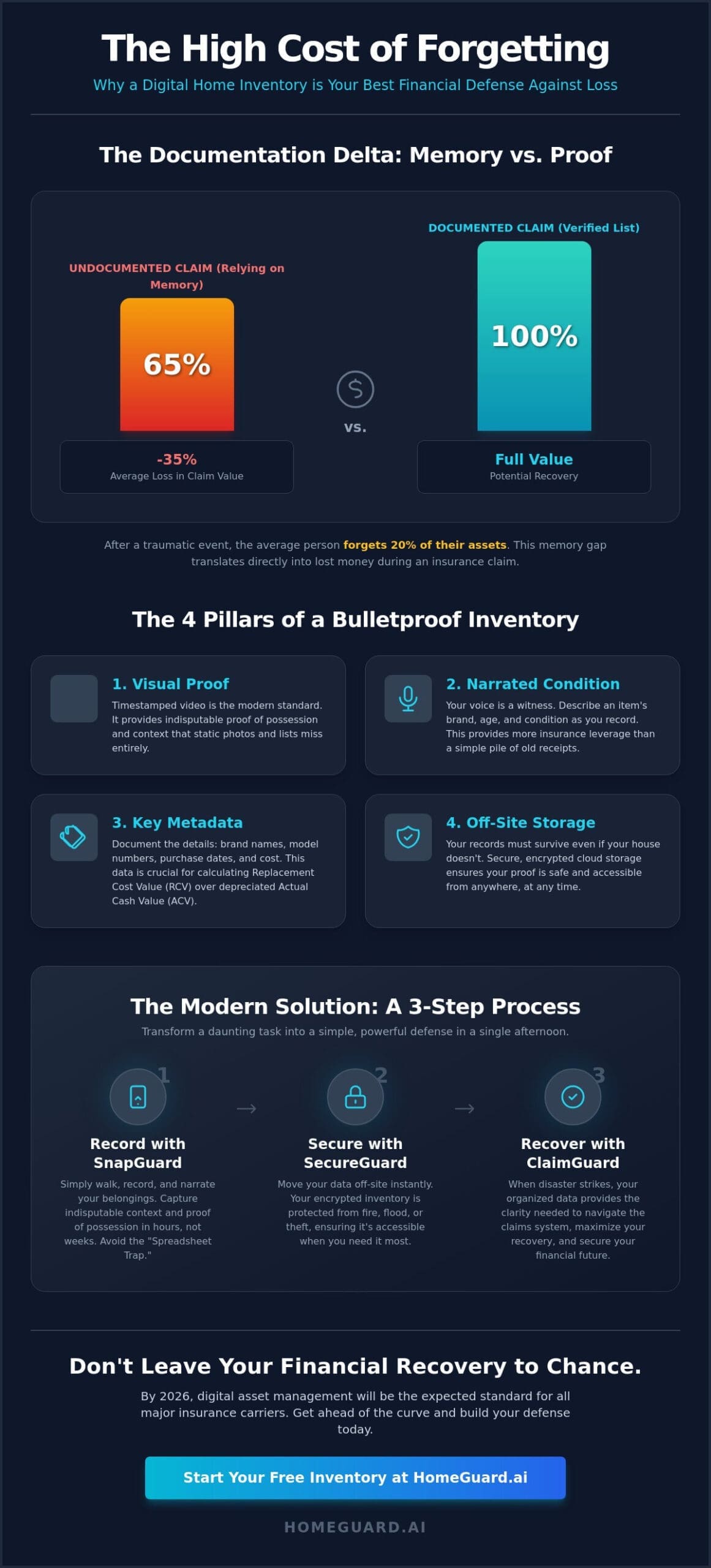
If a total loss occurred tomorrow, could you recall the brand, age, and cost of every item in your attic and guest closets from memory? You likely can’t. Data from 2025 insurance audits suggests that homeowners without digital documentation often recover 35% less in claim value than those with a verified list. Relying on your memory after a trauma is a high-stakes gamble you’re almost guaranteed to lose. Effective home inventory protection isn’t about sentiment; it’s about financial self-defense.
It’s natural to feel overwhelmed by the scale of documenting a whole house, and the fear of being lowballed by an insurance adjuster is a valid concern. We understand that the “before” is manageable while the “after” is pure chaos. This guide will teach you how to transform simple video and photos into a bulletproof defense for your assets. You’ll learn how to use SnapGuard to walk, record, and narrate your belongings in hours rather than weeks. By moving your data off-site with SecureGuard, you ensure your records survive even if your house doesn’t. We’ll show you how HomeGuard provides the clarity needed to navigate the system, using ClaimGuard principles to maximize your recovery and secure your financial future.
Key Takeaways
- Stop relying on memory after a disaster. Learn why most homeowners forget 20% of their assets and how to prevent that financial loss.
- Master the four pillars of a bulletproof record. Discover why “narrated condition” provides more insurance leverage than a simple pile of receipts.
- Avoid the “Spreadsheet Trap” through video-based home inventory protection. Capture context and indisputable proof of possession in minutes, not hours.
- Follow a methodical three-step walkthrough. Learn to secure your property from the exterior perimeter to the smallest interior details.
- Turn your documentation into a professional financial defense. See how systematic records simplify the ClaimGuard process for faster asset recovery.
What is Home Inventory Protection and Why Does It Matter Now?
Home inventory protection is a systematic method of documenting every physical asset you own to ensure full insurance reimbursement. It’s not a hobby or a weekend organization project. It’s a calculated financial defense strategy. Most homeowners assume they’ll remember their belongings after a disaster. They’re wrong. Data shows that the average person forgets 20% of their assets when filing a claim following a traumatic event. That’s a massive portion of your net worth simply vanishing because of a memory gap.
In the Kansas City region, the risks are concrete and increasing. In 2024, local storm damage claims rose by 15% due to unpredictable weather patterns and high-wind events. Whether it’s a flash fire in Overland Park or hail damage in Liberty, the chaos of the moment destroys clarity. To protect your investment, you must understand What is Personal Property? and how it’s classified. This includes everything from the electronics in your media room to the specialized tools in your garage. Without a verified record, these items don’t exist in the eyes of an insurance adjuster.
Investing in home inventory protection isn’t just about organization; it’s about financial self-defense. You’re building a bridge between the items you bought and the money you’re owed. Much like the professional electronic security solutions offered by Asset Resources Group, documentation is a proactive measure to protect your assets. If you don’t document it now, you won’t recover it later. It’s that simple.
True financial self-defense also means looking at the bigger picture of your family’s security. In addition to securing your property, you should explore Term Life Insurance Policies to ensure a complete safety net is in place for the future.
The Financial Delta of Documentation
The difference between a documented claim and an undocumented one is often tens of thousands of dollars. Documentation changes the fundamental math of your payout. Most policies offer Replacement Cost Value (RCV), but without proof, adjusters often default to Actual Cash Value (ACV). ACV subtracts depreciation, leaving you with pennies for items that cost thousands to replace. A professional inventory through HomeGuard closes this recovery gap by providing the “before” evidence required to trigger maximum payouts. Don’t leave your financial recovery to chance or an adjuster’s best guess.
Why 2026 is the Year to Automate
The era of handwritten lists and blurry Polaroids is over. By 2026, digital asset management will be the expected standard for all major insurance carriers. Adjusters now prioritize timestamped video evidence because it’s difficult to dispute and provides context that photos miss. You can use SnapGuard to walk, record, and narrate your home in a single afternoon. This creates an unalterable record of your legacy. As climate volatility increases, securing your data is as important as securing your doors. SecureGuard ensures your inventory is encrypted and accessible even if your physical home is unreachable. If the worst happens, ClaimGuard provides the organized data needed to fast-track your recovery process.
The Anatomy of a Bulletproof Inventory Record
A simple list of items isn’t enough to satisfy a modern insurance adjuster. You need a record that stands up to intense scrutiny. Effective home inventory protection rests on four pillars: visual proof, narration, metadata, and off-site storage. Without these, your claim is just a collection of guesses. Memory fails under stress; a systematic record does not.
Receipts are valuable, but they don’t tell the whole story. A 10-year-old leather sofa or a vintage watch likely won’t have a modern receipt. For these items, narrated condition is far more powerful. Describe the item’s state, its brand, and its functionality while you record; this is especially important for high-value custom gear from pinnacleconcealment.com. Doing so provides a clear picture of value that a faded piece of thermal paper cannot. Your voice acts as a witness to the asset’s existence and quality.
Don’t just go room by room. Categorize by asset value to prioritize high-ticket items first. You must also document invisible assets. Built-in shelving, high-end light fixtures, and HVAC upgrades are often missed because they feel like part of the house. They are actually significant investments. This Insurance Information Institute guide explains how missing these details can lead to massive gaps in your coverage. Protect what you own; recover what you lose.
Visual Proof: Beyond the Basic Photo
Static images are flat. They don’t prove a television actually turns on or that a high-end laptop screen isn’t cracked. SnapGuard uses video to capture every angle. It turns a static record into a dynamic proof of life for your electronics. Document serial numbers and brand markers clearly. It takes 15 seconds per item but saves 15 hours of disputes during the claims process. Clarity is your best defense against a denied claim.
Commonly Forgotten Items in Claims
Most people remember the 70-inch TV. They forget the 50 pairs of socks, the kitchen blender, and the contents of the junk drawer. These small items can total over $5,000 in a standard three-bedroom home. Fire victims often report that the hardest things to replace were the everyday essentials they forgot to record. Small appliances and linens add up to a significant financial hit if they aren’t documented. For a complete checklist, see The Ultimate Guide to Home Inventory.
Storing your data locally is a risk. If your house burns, your hard drive burns too. Investing in home inventory protection through SecureGuard ensures your data is encrypted and accessible from anywhere when you need it most. Visit homeguard.ai to start securing your assets today.
Video vs. Spreadsheets: Choosing Your Documentation Strategy
The spreadsheet trap is a silent killer of disaster preparedness. Most homeowners start their home inventory protection plan with a blank document and high hopes. They spend three hours cataloging a single kitchen drawer, get overwhelmed, and quit. Manual entry is slow. It is prone to typos. Worst of all, a spreadsheet alone often fails to meet the “proof of condition” requirements during a high-stakes insurance claim. If you cannot prove the item existed and was in good shape, the adjuster may offer a fraction of its value.
Video documentation provides the speed and context that text cannot match. It offers indisputable proof of possession. A single sweep of a room captures dozens of items in seconds. This visual evidence is a cornerstone of a successful recovery. Even the California Department of Insurance home inventory guide emphasizes that visual records are essential for identifying lost property after a disaster. Memory fails under stress; video does not. For most of your belongings, a narrated walk-through is the fastest path to a finished record.
The most effective strategy is a hybrid model. Use video for 90% of your home to capture volume and context. Reserve a digital home inventory spreadsheet specifically for your high-value assets. This includes jewelry, serialized electronics, and fine art. This approach gives you the granular data needed for expensive items while ensuring the rest of your home inventory protection is completed in hours, not months. At HomeGuard, we prioritize this efficiency because an unfinished inventory is the same as having no inventory at all.
The SnapGuard Protocol
The “Walk, Record, and Narrate” method is the core of the SnapGuard experience. You don’t need professional equipment. Just use your phone. Move through each room slowly. Open closets. Describe the brand and the approximate year of purchase as you film. This protocol captures proof of loss before the loss happens. By integrating your video with the cloud, you ensure that your documentation is timestamped and tamper-proof. It turns a daunting weekend project into a simple 5-minute task per room.
The SecureGuard Storage Solution
Keeping your inventory records on a local hard drive or a thumb drive is a critical mistake. If your home faces a fire or flood, your local backups will likely perish with your belongings. You need professional-grade off-site asset management. SecureGuard removes the risk of physical loss by hosting your data in a secure, encrypted cloud environment. This allows for instant retrieval from any smartphone. When you are standing in your driveway after a disaster, you can access every file and video immediately. This level of organization is what makes ClaimGuard so effective during the filing process. You aren’t guessing; you are presenting facts.
3 Steps to Secure Your Kansas City Property Today
Memory fails. When a disaster strikes, the stress of the moment wipes away your ability to recall every asset you’ve acquired over the last 15 years. You can’t afford to guess. In Kansas City, where storm damage can happen in minutes, your financial recovery depends on the precision of your records. Follow this structured three-step process to build a bulletproof defense for your assets.
Step 1: Establishing the Baseline
Start outside. Your property’s footprint is the first thing an adjuster evaluates. Record the siding, the roof condition, and the mature landscaping. In a total loss scenario, adjusters often overlook the $4,500 you spent on professional grading or the $7,000 deck expansion completed in 2022. Use HomeGuard templates to ensure you perform a structured sweep of the garage and shed. This establishes “pride of ownership.” It proves you are a meticulous owner, which builds immediate credibility with the insurance company and makes them less likely to challenge your valuations.
Step 2: Deep-Dive Documentation
Move inside and open every drawer. Closets hold hidden wealth that most homeowners forget to claim. A single dresser might hold $2,000 in clothing; a kitchen pantry can house $800 in small appliances. Don’t just take silent photos. Walk, record, and narrate. Explain why your 2021 electronics are high-spec, why your furniture isn’t the base model, or the specific features of specialized equipment like Carcode Mileage Blockers. Narrated proof is the verbal confirmation of an item’s make, model, and purchase date recorded in real-time to eliminate adjuster speculation. This level of detail is the gold standard for home inventory protection.
Step 3: Finalizing the Shield
A recording on a lost or damaged phone is a liability, not an asset. You must move your data to a secure environment immediately. Verify that your upload to SecureGuard is 100% complete. This encrypted platform ensures your inventory survives even if your hardware doesn’t. Share the access credentials with a trusted family member or the executor of your estate. Set a recurring 180-day reminder on your calendar for a “refresh” session. This ensures your home inventory protection stays current with your lifestyle.
Inventory isn’t a one-time event; it’s a habit. Adopt the “One-In, One-Out” rule for all major purchases over $500. If you buy a new 4K television, record the serial number and delete the entry for the old unit. It keeps your record lean and accurate. If you haven’t documented your latest acquisitions, do it now. Preparation is the only logical choice for the pragmatic homeowner.
Don’t leave your financial future to chance. Protect your investment with HomeGuard today.
HomeGuard Complete: From Documentation to Defense
Jane Miller lost her family home to an electrical fire in July 2022. Like most homeowners, she assumed her insurance policy was a safety net. She quickly realized the net had holes. When the adjuster asked for a line-item list of every asset in her kitchen, Jane’s memory failed. She couldn’t recall the brand of her espresso machine or the model of her high-end blender. This lack of evidence resulted in a settlement that was $14,000 less than the actual replacement cost of her belongings. HomeGuard was built to ensure no other homeowner faces that financial deficit. It turns the “I think I owned that” uncertainty into “Here is the proof” certainty.
The system is designed to streamline the ClaimGuard process before a disaster occurs. It moves you away from frantic, post-disaster guesswork. Effective home inventory protection requires a professional-grade approach. You don’t just need a list; you need a verifiable digital footprint. HomeGuard provides the clarity needed to navigate insurance bureaucracy. It’s about moving from a position of vulnerability to a position of strength. Protect what you own. Recover what you lose.
Why HomeGuard is Different
Traditional inventory methods fail because they rely on complex spreadsheets that nobody wants to update. HomeGuard replaces friction with intuitive, rapid-fire tools. We designed this system for the worst-case scenario to ensure you get the best-case recovery. It functions through the proprietary “GUARD” ecosystem: Snap, Secure, and Claim. You walk, record, and narrate. The system handles the organization. Memory fails, but documented evidence is indisputable. We focus on the inventory as a financial asset, not just a collection of memories.
- No spreadsheets: Forget manual data entry and lost files.
- Rapid-fire tools: Document an entire room in under five minutes.
- Professional-grade: Use the same logic adjusters use to verify claims.
Ready to Protect Your Investment?
The best time to document your home was the day you moved in. The second best time is right now. Every day you wait is a day your investment remains at risk. You wouldn’t leave your front door unlocked; don’t leave your assets undocumented. Getting started with HomeGuard Complete is the ultimate act of financial self-defense. It transforms a massive, overwhelming task into a manageable afternoon project. Don’t let a disaster dictate your financial future. Take control of your recovery today by securing the proof you need to win tomorrow.
Secure Your Financial Recovery Before the Storm
Memory fails when the pressure of a disaster hits. You’ve seen why manual spreadsheets and blurry photos are no longer enough to satisfy modern insurance adjusters. Effective home inventory protection requires a systematic approach that combines visual proof with verbal descriptions. By using our proprietary “Walk, Record, and Narrate” technology, you eliminate the ambiguity that leads to denied claims. It’s about proving what you own so you can recover what you’ve lost, and integrating this evidence into a secure digital vault for estate planning ensures your family has the information they need to manage your estate.
HomeGuard was founded by a residential fire survivor who understands the chaos of recovery. We’ve replaced the overwhelming task of cataloging with a streamlined, three-step process. Use SnapGuard for rapid documentation and rely on SecureGuard for secure, cloud-based retrieval when your physical devices are gone. If the worst happens, ClaimGuard provides the professional-grade evidence needed to defend your claim. Don’t wait for a crisis to realize your records are incomplete. Take control of your assets today. You’ve worked hard for what you have; now, make sure you can keep it.
Protect What You Own with HomeGuard Complete
Frequently Asked Questions
Is home inventory protection really necessary if I have good insurance?
Insurance is a legal contract that requires you to prove the value of everything you lost before you receive a payout. Good coverage doesn’t matter if you can’t substantiate your claims with evidence. Without professional home inventory protection, the average homeowner fails to account for 20 percent of their belongings during a disaster. Memory fails under stress. Use SecureGuard to ensure you recover every dollar you’ve invested in your property.
How much does a professional home inventory system cost?
Professional inventory services vary, but industry data from the National Association of Public Insurance Adjusters shows that undocumented losses cost homeowners tens of thousands of dollars. While we don’t list internal pricing, third-party professional inventory appraisals often range from $400 to $2,500 depending on your home’s square footage. HomeGuard provides a more streamlined, digital alternative to these traditional, high-cost manual audits that often take days to complete.
Can I just use my phone camera for a home inventory?
A phone camera is a starting point, but raw photos lack the metadata and organization required for rapid claim processing. Random images in a crowded camera roll are easily lost or accidentally deleted. SnapGuard turns your phone into a forensic tool. It allows you to walk, record, and narrate your assets. This creates a structured digital record that insurance adjusters can actually use to verify your home inventory protection.
What happens if I lose my receipts for older household items?
You can still claim items without receipts if you provide clear visual evidence and descriptive narration. Insurance companies accept secondary proof like serial numbers, model labels, and time-stamped video. According to the Insurance Information Institute, detailed visual documentation serves as a powerful substitute for missing paper records. SecureGuard stores these visual proofs in a secure, encrypted vault so they’re ready the moment you need to file a claim.
How often should I update my home inventory record?
You should update your inventory at least once every 12 months or after any purchase exceeding $500. Major life events like a kitchen remodel or a holiday shopping season also require a quick documentation refresh. Regular updates prevent a coverage gap where your insurance limit stays the same while your asset value grows. Use SnapGuard for a 15 minute walk-through once a year to keep your records current and accurate.
Is a digital home inventory spreadsheet safe from hackers?
Local spreadsheets are vulnerable to drive failure, fire, and basic cyber threats. A file sitting on your desktop is a single point of failure that can disappear when your hardware dies. SecureGuard uses bank-level encryption to protect your data from unauthorized access. This professional-grade security ensures your private asset list stays private. It’s significantly safer than a physical folder in a drawer or an unencrypted spreadsheet file on a laptop. For a professional-grade alternative, explore the 2026 digital home inventory spreadsheet from HomeGuard that keeps your data encrypted and accessible when you need it most.
Can an insurance company reject my video evidence?
Carriers can reject evidence if it’s blurry, undated, or lacks specific context. They need to see the item’s condition and verify it was actually in your home. This is why ClaimGuard focuses on high-quality, narrated evidence. By following a systematic walk and record process, you eliminate the ambiguity that adjusters use to deny claims. Clear, narrated documentation makes it nearly impossible for a company to dispute your ownership or the item’s value.
What is the fastest way to document a 4-bedroom house?
The fastest method is a narrated video walkthrough which takes about 45 to 60 minutes for a standard 4-bedroom layout. Don’t waste time typing individual serial numbers into a grid. Just open SnapGuard, start recording, and speak the details as you move from room to room. This narrative approach captures more data in 10 seconds than you could type in 10 minutes. It’s the ultimate efficiency for home inventory protection.