
Your memory is your biggest financial liability when disaster strikes. Industry research indicates that homeowners lose an average of 25% of their total claim value simply because they cannot prove they owned specific items. You likely feel overwhelmed by the volume of your possessions and the fear that an insurance adjuster will ignore your word alone. It’s frustrating to realize that without concrete proof, your premium payments are just a sunk cost. This article identifies the best home inventory app for 2026 to transform your household documentation from a chore into a professional-grade recovery strategy.
You will learn how to use SnapGuard to walk, record, and narrate your assets in hours rather than days. We’ll also explore how SecureGuard protects your digital records and how ClaimGuard accelerates the reimbursement process. By visiting HomeGuard, you’re choosing pragmatic preparation over post-disaster chaos. We’re reviewing the most effective tools to ensure your documentation is organized, secure, and ready for any adjuster.
Key Takeaways
- Stop betting your recovery on a memory that will fail during trauma; learn why adjusters only pay for what you can prove.
- Compare top-tier features to find the best home inventory app for your 2026 security strategy, focusing on AI automation versus total data privacy.
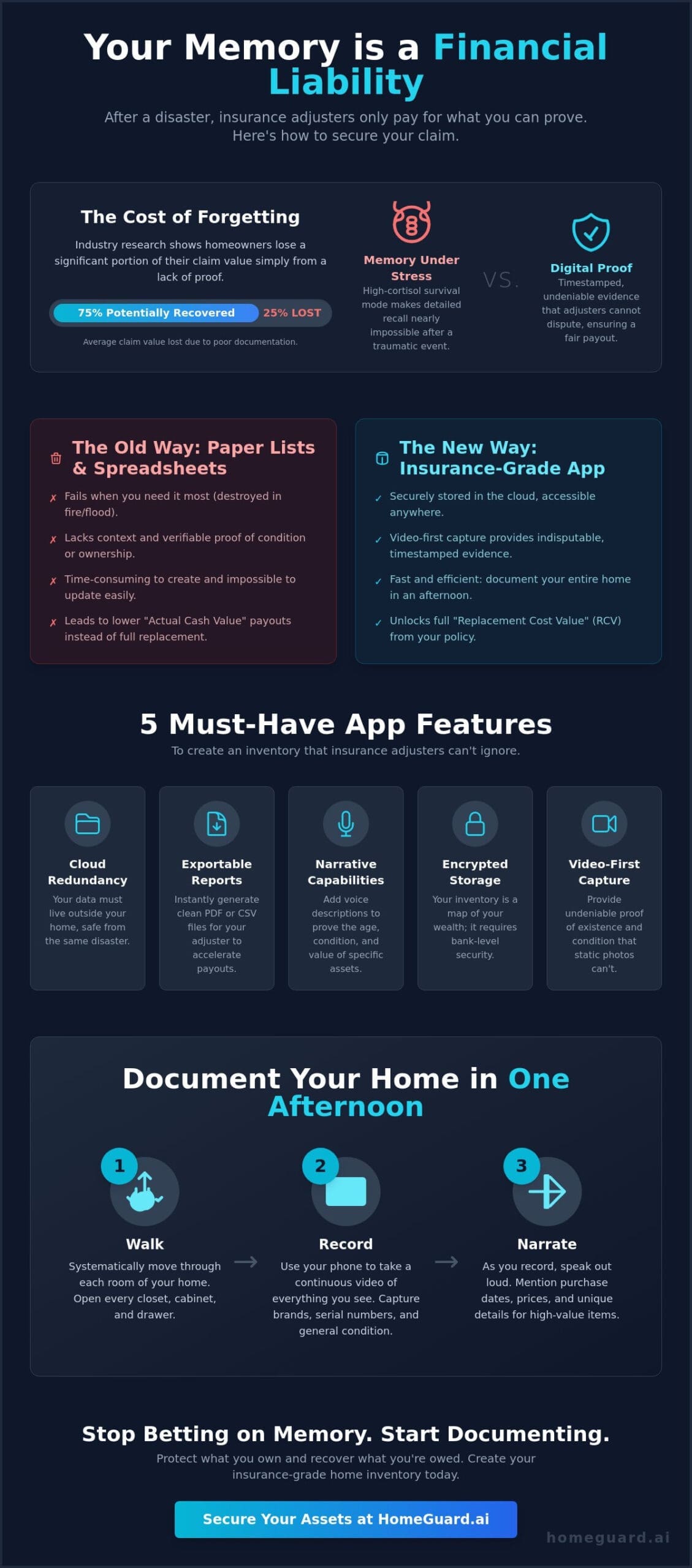
- Implement the “Walk, Record, and Narrate” system to document your “Big Five” high-value categories in just one afternoon.
- Ensure your evidence is bulletproof by prioritizing cloud redundancy and video-first capture over static, context-free photos.
- Discover how to use ClaimGuard to transform your inventory into a recovery weapon that bypasses the insurance depreciation trap.
Why Your Memory Is the Worst Home Inventory App
You think you will remember the brand of your television, the age of your refrigerator, or the contents of your hall closet. You won’t. When disaster strikes, the brain enters a state of high-cortisol survival mode. This psychological trauma makes detailed recall nearly impossible. Kansas City homeowners face specific, high-stakes risks like the 2023 spring storms that caused millions in property damage. In the aftermath of a fire or a tornado, your memory is a liability, not an asset.
The “Before vs. After” reality is stark. Documentation is a simple task today; it is an impossible burden tomorrow. Insurance adjusters are trained to pay for what you can prove. They are not your advocates; they are auditors. If you cannot provide evidence of ownership, the insurance company has no legal obligation to reimburse you for that item. This is why choosing the best home inventory app is the most critical step in your financial defense strategy. You must act while your home is intact. Once the walls are gone, your leverage in a claim vanishes.
The Financial Cost of Poor Documentation
Most Kansas City residents carry Replacement Cost Value (RCV) policies. These policies promise to pay what it costs to buy a new version of your lost items. However, RCV payouts are only triggered when you provide specific evidence of the item’s quality and age. Without proof, you receive Actual Cash Value, which is a fraction of the cost. The $10,000 mistake is common; homeowners routinely forget to document “invisible” assets like high-end linens, power tools, and kitchen gadgets. A digital inventory created through SnapGuard acts as a financial shield. It ensures you recover every dollar you are entitled to under your contents insurance policy.
Digital Records vs. Paper Lists
Paper lists are a legacy solution that fails exactly when you need it. If your house burns down, your paper list burns with it. If a pipe bursts and floods your basement, your handwritten notes become illegible. Digital records are the only logical choice for modern asset protection. By using a specialized home inventory system, you ensure your data is cloud-synced and accessible from any smartphone. Stop relying on fragile spreadsheets. You need a system that allows you to walk, record, and narrate your belongings.
- Instant Access: Retrieve your data via SecureGuard even if your phone is lost in the disaster.
- Verification: Provide timestamped video evidence that adjusters cannot dispute.
- Efficiency: Transition from a weekend-long project to a 20-minute walkthrough.
- Claim Readiness: Use ClaimGuard to organize your files before you ever call your agent.
The goal is simple. Protect what you own. Recover what you lose. Start your inventory at HomeGuard today before the next storm season arrives in the Midwest.
5 Must-Have Features for an Insurance-Grade Home Inventory App
Disaster doesn’t give you a heads-up. When a pipe bursts or a Kansas City storm tears through your roof, the immediate aftermath is pure chaos. You won’t remember the brand of your toaster or the specific model of your power tools while standing in a flooded basement. Memory fails under pressure. To recover what you’ve lost, you need more than a folder of blurry photos. The best home inventory app functions as a digital vault that meets the rigorous standards of insurance adjusters.
A professional-grade system must include these five non-negotiable features:
- Cloud Redundancy: If your inventory data only lives on your phone, it’s as vulnerable as your house. Your data must exist outside the physical walls of your home.
- Exportable Reports: You need the ability to hand an adjuster a clean PDF or CSV file instantly. Waiting days to compile a list results in delayed payouts.
- Narrative Capabilities: Static images don’t tell the whole story. Adding voice descriptions allows you to prove the age, condition, and specific brand of high-value assets.
- Encrypted Storage: Your inventory is a roadmap of your wealth. It requires bank-level security to prevent data breaches.
- Video-First Capture: This provides a “proof of life” for your belongings that photos simply cannot match.
According to financial experts at Forbes, maintaining a detailed home inventory is the single most effective way to ensure you receive a full settlement after a loss. Without it, you are essentially guessing at your own net worth.
Why Video Capture is the New Gold Standard
Taking 50 individual photos of a living room is tedious and prone to gaps. You’ll likely miss the expensive rug or the electronics tucked inside the cabinet. Video is different. By “sweeping a room,” you capture every item in its natural context in seconds. It’s efficient and undeniable. Video metadata, including time stamps and GPS location, adds a layer of authenticity that adjusters trust. Video inventory is the fastest path to proof.
Security and Cloud Access
Privacy is a major concern when documenting every asset you own. Many iOS-exclusive tools store data locally. If your phone is lost or destroyed in the same event that claims your home, your records vanish. You need a system that uses 256-bit encryption to secure your digital asset management. SecureGuard handles this by ensuring your files are encrypted both in transit and at rest. This level of protection keeps your personal information safe from hackers while keeping it accessible to you from any device, anywhere in the world. Don’t leave your financial recovery to chance; start building your secure record with HomeGuard today.
Comparing the Top Home Inventory Apps of 2026
Kansas City property owners face a crowded market when searching for the best home inventory app. The 2026 landscape is divided into three distinct categories: AI-driven scanners, management platforms, and privacy-focused local tools. Bevel leads the AI category by prioritizing speed; it uses spatial scanning to identify objects in seconds. HomeZada remains a powerhouse for homeowners who want to manage maintenance schedules alongside their assets. Under My Roof caters to the security-conscious by keeping data stored on local devices rather than the cloud. Each tool has a specific purpose, but they aren’t all built for the high-stakes environment of an insurance claim.
Free apps often lure users with zero upfront costs, but they frequently fail during a crisis. These basic tools lack the robust export formats that adjusters require. A California Department of Insurance home inventory guide points out that detailed descriptions and serial numbers are the foundation of a successful recovery. Generic tools like Google Drive or Evernote lack this necessary structure. They leave you with a chaotic pile of photos and no clear way to prove the value of your belongings. Specialized tools beat general-purpose apps because they are built with the claims process in mind. In the Kansas City market, where 15% of homeowners experience some form of property damage annually, having a professional-grade record is a financial necessity.
AI-Driven Apps: Speed vs. Accuracy
AI recognition tools like Bevel and InventAI promise to document a room in minutes. This speed is enticing for busy homeowners. You simply point your camera, and the app labels your “sofa” or “television.” However, speed often comes at the cost of precision. AI frequently misses the brand, model number, and purchase date; the exact details adjusters use to calculate depreciation. Data from 2025 shows that 22% of AI-generated inventory entries require manual correction to satisfy insurance requirements. AI fits best as a starting point in a hybrid strategy, but it cannot replace a narrated, human-verified record.
The Professional Choice: HomeGuard Complete
HomeGuard positions itself as the pragmatic protector for serious property owners. It doesn’t rely on gimmicks; it relies on evidence. The system was designed by a fire survivor who lost their home in 2021 and realized that memory fails when the smoke clears. This isn’t just an app; it’s a systematic defense for your equity. By using SnapGuard, you simplify the entire process. You don’t need to type long lists or struggle with spreadsheets. You walk, record, and narrate. This creates a timestamped, visual, and auditory record that is difficult for insurance companies to dispute.
The HomeGuard philosophy is simple: protect what you own and recover what you lose. While other apps focus on “organizing,” HomeGuard focuses on “proving.” It bridges the gap between a house full of items and a bank account full of recovery funds. For Kansas City residents, this professional approach provides the clarity needed to navigate the chaos of a major loss. No fluff. No missed details. Just a secure, organized, and professional inventory ready for when you need it most.
How to Document Your Home in One Afternoon
Most property owners in Kansas City wait until a disaster hits to realize they can’t remember every item in their basement or attic. Memory fails under stress. A manual spreadsheet takes days to compile and is often incomplete. You need a system that works in hours, not weeks. Utilizing the best home inventory app isn’t just about staying organized; it’s about financial self-defense. By using a structured methodology, you can turn a daunting task into a single afternoon of work. This ensures you have the proof required to recover every dollar from an insurance claim.
The Walk, Record, and Narrate Method
Speed is essential for consistency. Using SnapGuard, you can complete a whole-house sweep in approximately 20 minutes. Start at your front door and move clockwise through every room. Don’t just film the space; speak to the camera. Narrate the brand names, model numbers, and approximate purchase dates as you move. This audio data provides a secondary layer of evidence that adjusters can’t easily dismiss. Keep your movements steady. Use high-wattage lighting or a flashlight to ensure serial numbers are legible. If the video is blurry, the proof is gone. It’s a simple process: walk, record, and narrate.
Focusing on High-Value Assets
Don’t get bogged down by low-value items early on. Prioritize the “Big Five” first: electronics, appliances, furniture, tools, and jewelry. These represent the bulk of your financial investment. Once the major items are captured, focus on volume. Open your pantry, linen closets, and dresser drawers. An average kitchen pantry can contain over $500 in spices and staples; a linen closet often holds $1,000 in high-thread-count sheets and towels. If you don’t show the volume of contents, an insurance company will likely offer a minimum payout. For high-end items, use SecureGuard to link digital receipts and appraisals directly to your video files. This creates an airtight digital paper trail.
Remember to document “invisible” assets that don’t sit on a shelf. This includes expensive software licenses, digital media collections, and even professional services like custom cabinetry, built-in security systems, or specialized vehicle security from Lock and Track. These are frequently overlooked during the chaos of a claim. If you paid for it, you should be reimbursed for it. Using the best home inventory app allows you to categorize these intangible assets alongside your physical property, ensuring nothing is forgotten when the adjuster arrives.
Stop guessing what you own and start proving it. Secure your financial future with HomeGuard today.
Beyond the App: Turning Records into Recovery
An app is a tool. Recovery is the result. Using the best home inventory app isn’t just about making a digital list. It’s about building a financial fortress around your property. When a disaster strikes Kansas City, the window for recovery is small. You need to act fast. You need to be accurate. Memory fails during a crisis, but professional documentation does not. This is where your preparation pays off.
This level of preparation should also extend to your vital documents; platforms like SafeKeep help you master your digital life admin by centralizing all your important family records in one secure hub.
Filing Your Claim with Confidence
Insurance companies often rely on your lack of information. They expect you to be overwhelmed and exhausted. When you submit your records through ClaimGuard, you shift the leverage back to your side. A structured inventory removes the guesswork. It cuts down the weeks of administrative back-and-forth that usually follow a major loss. You become the most organized person in the room. This level of detail allows you to verify the adjuster’s initial estimate immediately. If they overlook a high-end appliance or a custom furniture piece, your documentation provides the immediate correction. You aren’t arguing; you’re proving.
The “depreciation trap” is where most homeowners lose money. Without proof of an item’s age and condition, adjusters default to the lowest possible value. Good documentation stops this. It shows the quality of your assets before the damage occurred. This is especially vital for “Special Limits” items. Most standard policies cap jewelry or collectible payouts at $1,500 total unless you have specific proof of possession. Without a clear record, those high-value assets are effectively uninsured.
Securing Your Financial Future
Kansas City storm seasons are relentless. In 2023 alone, regional storm damage resulted in millions of dollars in claims. A one-time commitment to HomeGuard ensures you are claim-ready before the clouds turn grey. It transforms a massive, daunting task into a simple walkthrough. You walk, you record, and you narrate. The system handles the rest. This isn’t just about organization. It’s about financial survival.
- Verify Estimates: Don’t let an adjuster’s 15-minute walkthrough dictate your payout.
- Beat Depreciation: Prove the condition of your assets to maximize their value.
- Protect Collectibles: Ensure your jewelry and electronics aren’t lost to policy caps.
The best home inventory app is the one that works when you need it most. Don’t wait for the next storm to realize you’ve forgotten half of what you own. Preparation is the only logical choice. Protect what you own. Recover what you lose. Visit HomeGuard to secure your Kansas City home today.
Stop Guessing and Start Guaranteeing Your Recovery
Memory is your greatest liability after a disaster. Statistics from the Federal Emergency Management Agency (FEMA) suggest that thousands of families struggle to rebuild every year simply because they lack documented proof of ownership. You don’t have to be one of them. By choosing the best home inventory app, you replace panic with a professional-grade system designed specifically for insurance claim recovery. HomeGuard was founded by a fire survivor who learned the hard way that a manual list isn’t a shield. It’s time to take control of your assets before the unexpected happens.
Our specialized SnapGuard video technology lets you walk, record, and narrate your entire property in one afternoon. Your digital records are then encrypted within SecureGuard and prepared for the ClaimGuard process. This isn’t just about organization; it’s about financial self-defense. Don’t let your hard-earned possessions become forgotten line items on an adjuster’s report. You’ve worked too hard to build your life to let it disappear without a trace. Secure your home and your financial future with HomeGuard today. We’re ready to help you protect what matters most.
Frequently Asked Questions
Is a free home inventory app enough for insurance purposes?
A free home inventory app often fails to provide the high-level security and detailed reporting required for complex insurance claims. Most free versions limit storage or lack the encrypted backup features found in the best home inventory app solutions. Without a professional-grade tool like HomeGuard, you risk losing your entire digital record if the app developer shuts down or your phone breaks. Professional platforms ensure your data remains accessible when you need it most.
How often should I update my home inventory app?
You should update your inventory at least 4 times per year or immediately after making a purchase over $500. Memory fails quickly; documenting assets while the receipts are fresh ensures you don’t lose money during a claim. Use SnapGuard to quickly record new items as they enter your home. Regular updates prevent the 30% undervaluation common in outdated disaster recovery files, keeping your financial defense current and accurate.
Can I use a simple Excel spreadsheet instead of an app?
Excel spreadsheets are better than nothing, but they lack the visual evidence and metadata insurance adjusters demand. A spreadsheet cannot store the 4K video or high-resolution photos necessary to prove the condition of your assets. Research shows homeowners using manual lists miss 20% of their belongings compared to those using a structured system. Avoid the chaos of manual entry and use a dedicated tool to secure your financial future and maximize your recovery.
What happens if I lose my phone and my inventory app data?
If your data is stored locally on your phone, a lost device means a total loss of your inventory. Professional systems like SecureGuard use encrypted cloud storage to ensure your records remain accessible from any device. This redundancy is critical because 1 in 4 people will experience phone damage or loss this year. Your recovery depends on data that exists outside of your physical hardware; cloud backups are the only way to guarantee survival.
Do insurance companies accept video inventories as proof of loss?
Most insurance companies accept video evidence, but a simple walk-through isn’t enough to maximize your payout. You must narrate the video and show specific brand names, model numbers, and conditions to satisfy adjusters. The best home inventory app will help you organize these videos into a format that ClaimGuard can use to expedite your filing. Detailed video documentation can reduce claim processing time by 15 days and eliminate disputes over item quality.
What items are most commonly missed in a home inventory?
Homeowners frequently forget to document “invisible” assets like high-end linens, power tools, and kitchen appliances, which can total $10,000 in value. Clothing and window treatments are also routinely overlooked during the post-disaster fog. By using a systematic “walk, record, and narrate” approach, you ensure these smaller items are documented. Don’t let your recovery budget shrink because you forgot the contents of your hallway closets or your garage shelves before the disaster occurred.
Is it safe to store photos of my valuables in the cloud?
Storing photos in a dedicated, encrypted cloud environment is significantly safer than keeping physical receipts or local digital files. Professional platforms use 256-bit AES encryption to protect your sensitive data from unauthorized access. This level of security ensures your inventory is available after a fire or flood while keeping your private information hidden. Trusting a secure digital vault is the only way to guarantee your records survive a total property loss without being compromised.
How does HomeGuard differ from standard organization apps?
HomeGuard is a specialized financial defense tool, not a simple organization app for tidying your pantry. While standard apps focus on aesthetics, our system is designed to prove ownership and value to insurance companies. We combine SnapGuard for recording with ClaimGuard for recovery. This focused approach turns your home inventory into a professional-grade asset report that protects your investment and ensures you aren’t forgotten by the insurance system.