
Your insurance company isn’t looking for a list; they’re looking for proof. Most people assume a few blurry photos and a dusty spreadsheet will secure their financial future after a fire or storm. They’re wrong. Memory fails when you’re standing in the middle of a loss. Without a professional house inventory app, you’re essentially handing your insurance adjuster a blank check. You need a system that narrates the value of your assets before the chaos begins.
We understand the dread of manual entry. You don’t have weeks to spend on a spreadsheet, and you shouldn’t have to. At HomeGuard, we believe in a preparedness-first philosophy. You can document every room in under two hours. This article reveals how to use SnapGuard to capture your home’s value and SecureGuard to keep that data claim-ready. We’ll show you how narrative documentation ensures you recover what you lose. By the end, you’ll have a roadmap to use ClaimGuard for a stress-free recovery. Protect what you own. Recover what you lose.
Key Takeaways
- Understand the “Memory Gap” and why homeowners typically forget 20% to 30% of their belongings during a traumatic insurance claim.
- Learn the “Walk, Record, Narrate” protocol to turn a standard house inventory app into a high-speed financial defense tool.
- Discover how SnapGuard eliminates inventory fatigue by documenting your entire home in under two hours.
- Secure your digital proof in a disaster-ready vault with SecureGuard to ensure your data survives when your hardware doesn’t.
- Transition from passive organization to active recovery by leveraging the complete HomeGuard ecosystem for total asset protection.
Beyond Organization: Why You Need a Disaster-Ready House Inventory App
Most people treat a house inventory app like a digital shoebox. They use it to organize their closets or track their collections. This is a strategic mistake. A true disaster-ready app is a financial defense tool. It is your primary weapon against an insurance company’s attempt to underpay your claim. It doesn’t just list what you have; it proves what you are owed.
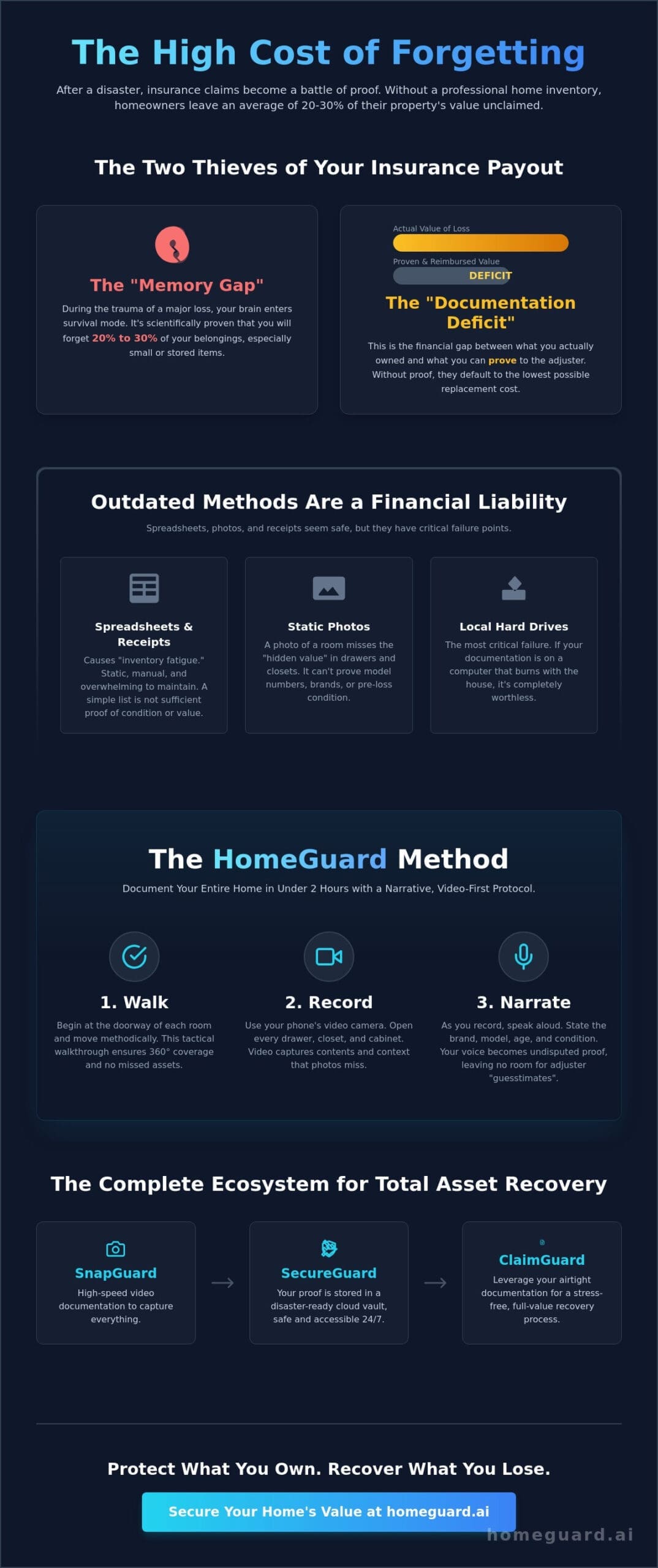
The “Before” stage of documentation is calm and methodical. You have the luxury of time to record every asset. The “After” stage is pure chaos. When disaster strikes, your brain enters survival mode. Research indicates that victims of major property loss forget 20% to 30% of their belongings during the initial claim process. This is the “Memory Gap.” You will stand in a pile of debris, trying to remember the brand of a toaster you bought four years ago. Memory fails. Documentation persists. Without a professional record, that 30% of forgotten items becomes lost money that never returns to your bank account.
Insurance adjusters require “Proof of Loss.” A simple list of items is insufficient for a full payout. They need to see the condition, the brand, and the existence of the item before it was destroyed. If you cannot prove the specific model of your refrigerator or the quality of your power tools, the adjuster will default to the lowest possible replacement cost. You need a system that narrates the value of your assets before the disaster occurs.
The High Cost of Poor Documentation
Insurance companies are businesses focused on the bottom line. They use depreciation and “missing information” to minimize their liability. If you describe an item as “a television,” they will reimburse you for the cheapest, most basic model available. For Kansas City homeowners, this risk is highest during the peak storm seasons of April through June. One hail storm or microburst can wipe out decades of equity in minutes.
The “Documentation Deficit” is the difference between what you owned and what you can prove. This deficit is where your money disappears. Without professional tools like HomeGuard, you are leaving your financial recovery to chance. You must close the gap between your actual loss and your documented proof.
Why Spreadsheets and Photos Aren’t Enough
The “shoebox of receipts” method is dead. Receipts fade and spreadsheets are static, manual, and overwhelming to maintain. Even photos have critical failure points. A photo of a living room does not show the model number of the soundbar or the specific contents of the media cabinet. Static images fail to capture “hidden value” tucked away in drawers and closets.
You need a system that narrates the story of your assets. By using SnapGuard, you move beyond flat images. You create a narrative record that leaves no room for adjuster “guesstimates.” This data must be stored in a cloud-based, secure environment like SecureGuard to ensure your proof survives the very disaster you are preparing for. If your documentation is on a hard drive that burns with the house, it doesn’t exist.
The SnapGuard Method: High-Speed Documentation for Modern Homeowners
Inventory fatigue is the primary reason most homeowners fail to protect their assets. They start a manual spreadsheet, get overwhelmed by the first kitchen drawer, and quit. SnapGuard was engineered to solve this specific failure point. By moving away from tedious data entry and toward a video-first approach, you can document an entire property in under two hours. This isn’t just a list; it’s a narrative defense. It turns a daunting weekend project into a fast, manageable task.
Traditional house inventory app methods rely on static images. A photo of a closed cabinet tells an insurance adjuster nothing about the contents inside. Video narration provides the context they cannot dispute. It captures the brand, the age, and the pristine condition of your belongings in real time. When you record, you aren’t just showing an object; you are proving its existence and its value. This transition from “listing” to “narrating” is what wins claims. If you don’t document it now, you won’t remember it later. Memory fails. Narrative proof persists.
Step 1: The Tactical Walkthrough
Efficiency requires a plan. Start at the doorway of each room and move clockwise to ensure 360-degree coverage. Opening every drawer and closet door is non-negotiable. Adjusters can’t pay for what they can’t see. Ensure your lighting is bright enough to capture serial numbers on electronics and appliances. Use your phone to zoom in on labels and tags. A steady, methodical pace ensures the HomeGuard system captures every asset with professional-grade clarity. This tactical approach eliminates the “overwhelming” feeling of a full-home audit.
Step 2: Narrating the Value
Your voice is the most powerful tool in your inventory kit. As you walk, speak clearly about what the camera sees. For example: “This is a 2024 Sony 65-inch OLED, purchased for $2,000.” This verbal record removes all ambiguity. It anchors the item to a specific value and date. This makes it much harder for an insurance company to apply aggressive depreciation or claim the item was of lower quality. Psychologically, talking through your assets reinforces the reality of your investment. It shifts your mindset from a passive owner to a pragmatic protector. You are building a vault of evidence. If the worst happens, you’ll be ready to recover every dollar you deserve.
Essential Features: What Separates a Recovery Tool from a Simple List
A basic list tells you what you have. A professional recovery tool tells the insurance adjuster what they owe you. Most competitors offer a digital notepad disguised as a house inventory app. They focus on organization, but organization doesn’t pay the bills after a total loss. At HomeGuard, we utilize the “Guard” philosophy: Protection, Proof, and Recovery. This framework treats your home as a high-stakes investment portfolio rather than a collection of stuff. It is the difference between a hobbyist’s list and a professional’s defense.
Digital Asset Management is now the professional standard for home inventories. It moves beyond simple photos into a structured data environment. For high-value assets like jewelry, fine art, or specialized equipment, SecureGuard provides a dedicated management tier. This ensures your most expensive items have the specific documentation required to bypass standard policy limits. This includes appraisals, certificates, and high-resolution video proof. Don’t settle for a generic list when your financial security is on the line.
Cloud Security and Data Integrity
Local storage is a single point of failure. If your inventory lives only on your phone or a laptop, it is as vulnerable as your furniture. In a house fire, local devices are often destroyed or inaccessible. Cloud-based redundancy is mandatory for a house inventory app to be effective. Your data must exist in a secure, remote vault that you can access from any device, anywhere in the world. If your proof burns with the house, it doesn’t exist.
Data integrity also relies on timestamped metadata. This is the invisible layer of proof that adjusters look for. A photo or video taken today has a digital signature proving it was created before the claim date. This prevents “fraud flags” and streamlines the verification process. When combined with professional-grade encryption, your personal property data remains private yet accessible when you need it most. For business owners who need to maintain this same level of data integrity and protection, M.I.S. Support, Inc. provides specialized cybersecurity and managed IT services. Protect your proof before the disaster strikes.
Integration with the Claims Process
Documentation is only half the battle; recovery is the other. Your inventory system should interface directly with ClaimGuard for a seamless transition from loss to payout. This integration allows you to export data in an “Adjuster-Ready” format. You aren’t handing the insurance company a messy pile of notes. You are handing them a professional, verified report that follows their own internal logic. This reduces friction and eliminates excuses for payment delays.
Professional documentation leads to faster settlements. Industry data suggests that well-documented claims can be processed up to 40% faster than those relying on memory alone. By using a system designed for recovery, you reduce the time spent arguing with adjusters and increase the speed of your rebuild. Stop guessing and start proving. Preparation is the only logical choice for the modern homeowner.
Two Hours to Peace of Mind: Your Kansas City Documentation Strategy
Kansas City homeowners face unique regional risks. Our peak storm season, typically running from April through June, brings hail and high winds that can compromise a property in minutes. You cannot afford to wait for a disaster to occur before you act. Procrastination is a financial risk. We recommend a One-Day Sprint approach to documentation. This concentrated effort ensures your records are complete before the next storm siren sounds. A professional house inventory app should facilitate speed, not hinder it. By committing to a single two-hour block, you move from vulnerability to total preparedness.
The goal is to be claim-ready by sunset. Start with a methodical walkthrough using SnapGuard. Don’t worry about perfect cinematography. Focus on visibility and narration. If you own high-value collections, such as specialized tools or heirloom jewelry, prioritize these for SecureGuard management. This ensures that your most significant investments receive the professional-grade documentation required by adjusters. Preparation is the only logical choice for the pragmatic homeowner.
Prioritizing the High-Value Rooms
Start where the money is. The kitchen and living room are almost always the most expensive rooms to replace. In suburban Kansas City homes, custom cabinetry and high-end built-in appliances represent tens of thousands of dollars in equity. When documenting these areas, open every cabinet. Record the brand names of your range, refrigerator, and dishwasher. For a deeper look at room-by-room strategies, consult The Ultimate Guide to Home Inventory. Capturing these details now prevents the insurance company from defaulting to “builder-grade” replacement costs later.
The “Invisible” Assets: What Most People Forget
Claims are often lost in the details. Most homeowners forget the “invisible” assets: linens, clothing, and pantry items. This is “death by a thousand cuts” in the claims process. Replacing a full wardrobe or a stocked pantry can cost thousands of dollars, yet these items are rarely documented. Move to the garage and attic next. Capture your power tools, outdoor equipment, and seasonal storage. For more advanced asset recovery strategies, read our guide on Home Inventory Protection. Don’t leave your recovery to chance. Use your house inventory app to document the small things; they add up to significant settlements. You deserve a full recovery, and HomeGuard is here to help you secure it.
HomeGuard AI: The Complete Ecosystem for Total Asset Recovery
Most digital tools are built by software developers who have never filed a major insurance claim. HomeGuard is different. We don’t provide a simple list; we provide a financial defense ecosystem. Choosing a generic house inventory app might help you organize a closet, but it won’t help you win a disputed claim. HomeGuard is the only choice for pragmatic protection because it was designed for the “After” scenario. We prioritize your financial recovery over aesthetic organization. It is a professional-grade system for a high-stakes problem.
The power of our system lies in the synergy between our specialized tools. SnapGuard handles the high-speed video capture, ensuring you document your assets in hours rather than weeks. That data is then moved into SecureGuard, an encrypted vault that keeps your proof safe from the very disasters you’re documenting. Finally, ClaimGuard provides the professional roadmap needed to turn that proof into a check. This is a closed-loop system. Protect what you own. Recover what you lose.
Developed by a Survivor, Built for You
HomeGuard was forged in the aftermath of a devastating Kansas City house fire. Our founder stood in the debris of his own home and realized that memory fails when trauma hits. He learned that insurance adjusters don’t pay for what you remember; they pay for what you prove. This experience led to “empathy-driven engineering.” We understand the chaos of a claim because we’ve lived it. This makes HomeGuard more than a tech company. We are your recovery partner, providing the clarity and structure you need when the system feels designed to forget you.
Getting Started with HomeGuard Complete
The HomeGuard Complete package is your all-access pass to total asset protection. It includes the full suite of SnapGuard, SecureGuard, and ClaimGuard services. You don’t need a degree in insurance adjusting to get started. The interface is intuitive and functional. You can download the house inventory app and start your first SnapGuard video in minutes. No spreadsheets are required. Just walk, record, and narrate. A small investment in documentation today prevents a massive financial loss tomorrow. Don’t wait for the next storm siren to realize you’re unprepared. Secure your home today with HomeGuard and gain the peace of mind that comes with being claim-ready.
Secure Your Financial Recovery Before the Next Storm
Memory fails when the pressure of a disaster hits. You now understand that a simple list is a liability, not an asset. By adopting a professional house inventory app that prioritizes narrative proof, you eliminate the “Memory Gap” that often costs homeowners 30% of their total claim value. You have the strategy to document your property in under two hours. You have the tools to turn potential chaos into a structured, successful recovery. This is about more than organization; it is about financial self-defense.
HomeGuard was developed by a fire survivor who understands that cloud-secure data storage is the only way to ensure your proof survives. We provide adjuster-approved documentation formats that stop the underpayment cycle before it starts. Don’t leave your financial future to chance or a dusty spreadsheet. Acting before the disaster is the only logical choice for the pragmatic homeowner. Protect what you own. Recover what you lose.
Protect Your Home with HomeGuard Complete
Take control of your assets today. You’ve done the work to understand the risks. Now, take the final step to ensure your family’s security is never in question.
Frequently Asked Questions
Is a house inventory app really better than a manual spreadsheet?
Yes. Manual spreadsheets are static and lack the visual proof required by insurance adjusters. A professional house inventory app like SnapGuard captures video and audio context that a cell in a spreadsheet cannot provide. Research shows that memory fails by 20% to 30% after a traumatic event. A spreadsheet can’t narrate the details of what you’ve forgotten, but a video record persists.
Can I use a house inventory app for renters insurance too?
Absolutely. Renters often underestimate their total asset value by 50% or more. Whether you own the home or just the contents, you need a digital record to prove your loss. Using a house inventory app ensures you receive a full replacement cost payout for your furniture and electronics. Don’t settle for a depreciated estimate because you lacked the proof to back up your claim.
What happens if I lose my phone during a fire? Is my inventory safe?
Your data is safe only if you utilize cloud-based storage. If your inventory lives only on your physical device, it burns with the house. SecureGuard stores your documentation in a secure, remote vault. You can access your proof from any computer or new device to start your recovery process immediately. Your documentation must exist outside the disaster zone to be effective.
For business owners who want to apply this same principle of disaster-proof digital storage to their companies, check out CX IT Services for professional cloud and IT support.
Do insurance companies actually accept video inventories as proof?
Yes, adjusters prefer video because it provides 360-degree context that photos miss. A video showing a working, high-end appliance is much harder to dispute than a single, blurry image. Professional documentation through HomeGuard follows industry-standard formats. This clarity leads to 40% faster claim settlements based on recovery data from major carriers. It removes excuses for payment delays.
How often should I update my home inventory app?
Update your record once a year or after any major purchase over $500. Most homeowners neglect this, which leads to a Documentation Deficit when they try to file a claim. A quick 10-minute walkthrough with SnapGuard every January ensures your coverage matches your actual assets. Don’t let your proof become obsolete while your home’s value grows. Preparation is a continuous process.
What are the most common items people forget to include in their inventory?
People consistently forget “invisible” assets like linens, pantry stock, and holiday decorations. These items can total over $5,000 in a typical suburban home. They also miss professional tools in the garage and seasonal items stored in the attic. Use a systematic room-by-room approach to ensure you don’t leave money on the table. Every item you forget is money that stays in the insurance company’s pocket.
Is my data private? Who can see my home inventory?
Your data is private and encrypted. Only you have access to your SecureGuard vault unless you choose to export a report for a claim. We use professional-grade encryption to protect your personal property data from external threats. Your inventory is a significant financial asset. We treat it with the same level of security you would expect for a bank account or investment portfolio.